It was a delicious surprise, arriving from home to Edinburgh Airport 2 weeks ago, to discover that my flight down to London – the first leg of my much longer journey to Hong Kong – was going to be on a 787. For a route which usually involves the considerably less glamorous prospect of an Airbus A320, this felt like an unexpected upgrade in the day, although I accept that I was probably rather more pleased by it than the circumstances strictly justified. Still, retaining childlike joy in one’s life is to be commended, I would argue.
There was another surprise once I was on board, which was that (a) there were Club Suites, and (b) the in-flight entertainment worked; struck by the novelty of this, I abandoned my worthy intention to spend the flight working through a set of Board papers, and decided instead that I could just about squeeze in a film before landing at Heathrow. And so it was that I came to watch Pressure, the story of the meteorologists trying to forecast the weather for D-Day … and by the time we touched down at Heathrow, I had entirely forgotten that the Board papers were still sitting unopened, because I had found myself thinking instead about judgement, expertise, uncertainty and leadership.
The dilemma at the heart of the film is deeply embedded in Western history, and is this: an invasion of extraordinary scale has been assembled, involving thousands of ships and aircraft, hundreds of thousands of people and months or even years of planning, and somebody has to decide whether the weather will allow it to proceed. The difficulty, of course, is that there is no certainty to be had … there is data (but not enough of it – and, we are reminded, overwhelmingly analogue – no AI to help on this occasion), there is expertise (but disagreement between experts), and there are patterns which can be interpreted in more than one way, while all the time the pressure to produce something resembling an answer becomes greater.
What interested me, of course, was not really the meteorology, fascinating though that was, but the point at which expertise ceases to be able to tell us what to do, and judgement has to take over. There is actually something rather personally exposing about that moment for leaders, because it requires them not only to have knowledge and experience, but also the courage to say, after all the analysis, questioning and argument, “this is what I think”. Even more courageous, at times, is to say “I am not yet sure”, or simply “no”.
Leadership, as I have often said, is an odd thing … and the perception of what leadership should be, is arguably even more of an odd thing. For all sorts of reasons, probably rooted in patriarchal histories, we are still inclined, I think, to place quite a high premium on certainty in leaders, and perhaps even to mistake this certainty for competence. Someone who answers quickly, speaks firmly and gives an impression of conviction can appear reassuringly leader-like, while the person who pauses, asks another question, or admits that something does not yet quite fit can seem less decisive. Watching Pressure, I found myself wondering whether some of our most serious errors as leaders occur precisely at that moment when our confidence skips ahead of our judgement, or when our desire to appear certain becomes stronger than the discipline of remaining connected to what is actually happening.
This is not to say, of course, that there is no place for confidence and quick answers; a devotee as I am of the listening and understanding embedded in coaching, I do frequently say that if a photocopier isn’t working, then the user does not want to be asked their opinion about why it isn’t working. (“JUST TELL ME HOW TO MAKE IT WORK!!”) However – and in particular in the glorious complex environments of schools – we rush to answers at our peril. Schools are places where knowledge is scattered in all sorts of places, often a long way from the formal centre of power. A teacher notices a subtle change in a child which no dataset will reveal; a receptionist hears the same concern expressed by several parents before anyone has thought of it as a pattern; a teaching assistant knows why something which appears entirely sensible on paper will not work with a particular group of children; someone in Admissions senses a shift in the market before it becomes visible in the numbers, while a middle leader may know, with considerable precision, that one more (no doubt excellent) initiative is about to land on a team which has very little capacity left.
The knowledge of a school lives all over the place, which means that one of the most important tasks in leadership is to create the conditions in which that knowledge can travel, be heard and be brought into relationship with other knowledge. That requires leaders to remain sufficiently close to the reality of the organisation to understand what they are hearing, without succumbing to the illusion that they themselves must see, know or solve everything; equally – and of the utmost importance – it requires people throughout the organisation to exercise their own judgement, to bring forward not only problems but possible solutions, and to understand that leadership is something in which they too have a part. There will, of course, come a point when a judgement has to be made by those tasked with the role of leadership … and when it is, the collective responsibility shifts again, namely towards making that decision work, bringing a positive, disciplined energy to its implementation, while continuing to notice – and to say – what reality is revealing.
Pressure was not a story about one gifted individual somehow finding the answer. Group Captain James Stagg, the (Scottish, note …) Chief Meteorologist could not possibly gather all the observations himself, nor could he personally possess every strand of expertise needed to interpret them. Rather, he relied on other people, spread across different places and working with different information, each seeing only part of the picture and each bringing something particular to the attempt to understand the whole. His task, in fact, was not actually to know everything, but to keep all of that distributed knowledge connected – to one another, to the reality they were trying to understand, and, above all, to the mission which gave their work its urgency. The point of the weather charts and observations was not the elegance of the analysis, but the fact that people would live or die according to the quality of the judgement that emerged from it. The lesson of Pressure, therefore, is not that leaders themselves need to have better answers, compelling though that idea can be, but rather that they need to build organisations in which better answers have a chance of being found. That, above all, it strikes me, is one of the fundamental skills of leadership.
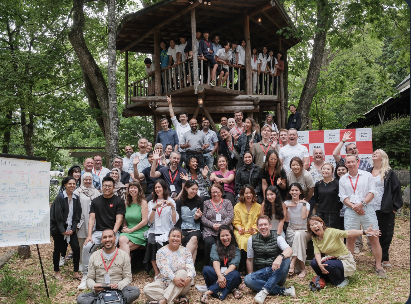
I am headed to Tokyo later today, and from there to the refreshing mountain air of the Japanese Alps, to participate in the annual Hakuba Forum led by the inspirational team at Hakuba International School, and the wonderful Russell Cailey. The theme this year is ‘Designing Schools for Wellbeing’, and I am certain that the deep reflection and connection that this Forum always enables will prompt even further reflection on leadership – mine, yours, ours.
Watch this space …
