‘It’s all pants’: gender equality and the school uniform debate

A mother in Melbourne has been causing a bit of stir recently, with her petition to the Education department and her local school to allow her daughter to wear trousers (pants) to school rather than the mandated school uniform dress. A media storm has been whipped up, and she has been accused of undermining the authority of schools, and while many people have spoken up in support (not least the 17,000+ supporters of the petition to date), a lot of mud is being slung around. This has continued even since the school has agreed to the uniform change – ‘what kind of an example is she setting her daughter by letting her get her own way?’ is a fairly typical response.gender equality

Read the petition itself, however, and you will see a very considered, thoughtful piece on why dresses can disadvantage girls in many ways: “Dresses disadvantage girls like my daughter who want to play footy, run, climb and ride a bike to school. The boys get to wear pants and shorts which facilitate these activities far better than a dress. I won’t stand for a policy that only encourages and promotes girls to be active on sports days (at my daughter’s school this is twice per week). What about the rest of the time?”

This mother points to research and documents from the State Government which acknowledge that uniform can hold girls back from physical activity, and she demonstrates too that she has tried to follow procedure by approaching the school directly; there was no school board to whom she could turn, so she raised her voice and spoke out. For her, this is a real question of gender equality: “My daughter, like many other girls, simply wants the choice to wear pants like half of her peers, with the warmth and freedom to be active at school and travelling to/from school. She constantly asks “why can’t I wear pants like the boys?” “Because you’re a girl” is not something I am prepared to say to my 6 year old daughter. A daughter who I have raised to believe she can do and conquer anything, regardless of her gender, and that she can like what she wants to like and not what gender stereotypes dictate she should like.”

At my lecture on ‘Bringing Up Girls’ this week at St Mark’s Darling Point, during my visit to Sydney from the UK, I explored how we can support our daughters (and granddaughters, nieces, goddaughters and all other girls) by listening to them, understanding the pressures of their world, and helping them to navigate these pressures. One of the most important things we can do to help them is to show them how not to accept inequality, and as adults (and parents) we too need to call out inequality when we see it. We may have come a long way in a short space of our history to enable greater equality for girls and women, but there is a long, long way to go until we really can lay a claim to true equality – an equality which benefits everyone.

The aggressive nature of the debate that has grown around the petition started by this mother does not stem from her words or actions. On the contrary – she is seeking a legitimate way to raise her voice: a process that we should value in our democratic and civilised society, having explored other ways to tackle the problem. She deserves – everyone deserves – a respectful hearing, followed by active and supportive engagement in how to create a solution.

Moreover, this is an incredibly important issue, and she deserves further respect for having the courage to focus on it, and to speak out about it. It may be hard for us generally to accept that school uniforms have inequality embedded within them, because for years this was not on our radar, and we are heavily influenced by a history in which school uniforms represent so much more for us than just clothes – they stand for rigour, discipline, tradition. However, now that we have realised that they disadvantage girls, we need genuinely to look at our school uniforms, and – even better – to engage girls and parents in the debate about how to change them.

Gender equality really, really matters – and nothing is served by either trivialising the issues or by aggressively attacking those who raise them. School uniforms need to be back on the agenda – and we need to iron out inequality, one uniform at a time.


Speaking in public: an introvert’s perspective

I am speaking to two different audiences this week in Sydney, on two of my different specialisms; a seminar on Powerful Schools at Macquarie University School of Education on Wednesday, and a public lecture and discussion at the renowned St Mark’s Darling Point on ‘Bringing Up Girls’ on Thursday evening. As an introvert who has learned to develop a number of extrovert traits, I still ask myself occasionally ‘why put myself through the trial of speaking in public?’, but the answer is always definitively clear, and worth exploring here.

What drives me to speak and to lead discussion is, I realised a number of years ago, a passionate belief in the power of human beings to solve problems through collaboration. My role as a speaker is to share thoughts and ideas – and, by doing so, not simply keep observations and insights to myself that people may not otherwise be able to access because they are not deeply embedded in the same field. Having developed expertise and a specialist knowledge in an area of human activity that touches us all – young people, and education in its broadest sense, as a driver of future thinking in our society – gives me a privileged platform, and it is, I believe, my moral responsibility to use that platform to help fellow human beings through the sharing of insights, and through prompting and challenging their thinking.

speaking in publicThe key word, of course, is ‘sharing’. The best speeches, I feel, are those which create a safe space for people to be able to think, to ask questions, to ponder the answers, and to incorporate the thoughts and ideas of others into their own framework of thinking, which has been shaped over the years. Listening to a speech should not be a passive process – the brain will absorb, questions and reframe ideas according to its own experience, and if the person listening feels safe and able to ask questions, then not only does this reframing become even more personally pertinent, but it can enable the rest of the audience – and the speaker – to extend the scope of the ideas being discussed, and to take them into new areas of reflection.

I have always thought that the discussion following a speech is immensely valuable – the speech itself is an introduction to ideas, and a powerful vehicle for the sharing of thoughts and deep experience, but the subsequent discussion enables those thoughts to be owned and turned into something practical and used as the basis for further thinking and reflection. The speech itself acts as a catalyst and inspiration, and the real value happens as these ideas and experiences, carefully set out and communicated as clearly as possible, meet the minds and experience of other people, who can turn these insights into something meaningful for them – something that has the potential to influence their future actions and may help them make changes that will benefit themselves and others.

And of course, my speeches are all about change. Not drastic change (at least, not usually), but nonetheless fundamental change in our thinking, our actions, our relationships with others and with society more generally. As a human race, I believe that we are hard-wired to keep moving, questing, improving, doing things better and better for one another and for the world as a whole. Every day we take decisions and do things that make a difference, and the more deeply we can think about how to connect these decisions and actions, the more likely it is that we will be able to turn them into a greater collaborative striving for improvement.

This is what motivates me – and I hope that it inspires and catalyses in equal measure. And this is why I am looking forward to this week.

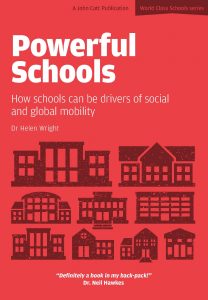
Dr Helen Wright’s latest book, Powerful Schools: How schools can be drivers of social and global mobility, is available from the John Catt Educational Bookshop and on Amazon. Her widely-read book on bringing up girls, Decoding Your 21st Century Daughter, is available as a paperback and Kindle edition on Amazon.

Women: disadvantaged from childhood

If you read only one PhD thesis this year, make it this one. And if you only read one chapter of this thesis, make it Chapter 7 (which you will find on pages 175-249), entitled ‘The CEO habitus’. Submitted to the University of Queensland in 2011, this thesis is the work of Dr Terrance Fitzsimmons, who spoke earlier this week at the Alliance of Girls’ Schools Australasia conference in Brisbane, and in exploring the outcomes of the unique studies he undertook, he manages to uncover some essential facts about women’s pathways to the top of their careers. These facts, when shared widely and discussed, have the potential to shift on to a new level our awareness and understanding of gender inequality in our society. They are significant findings.

In preparation for his thesis, Terrance Fitzsimmons interviewed a sample of 31 female and 30 male CEOs from publically listed and large private sector Australian companies, and interviewed them about their life journeys. He used the framework of Pierre Bourdieu, the French sociologist and philosopher who died in 2002, to explore what Bourdieu called the ‘habitus’ of each person. As Fitzsimmons describes it,

“Bourdieu (1977) conceived of habitus as being the embodied history of each person. He proposed that habitus is the sum of experiences, accumulated over a lifetime, used by the individual both consciously and sub consciously. Bourdieu (1990) viewed childhood as being pivotal in habitus formation. The imprinting in early childhood of “proper‟ ways of behaving and interpreting the world form the basis of all meaning making by children at school and then, in turn, later in their career. This early learning becomes “the taken for granted‟ or “the social rules of the game of life (Jenkins, 2002; Taylor, 1999).” (Fitzsimmons, 2011:175)

In his interviews and subsequent analyses of the interviews, Fitzsimmons discovered a remarkable difference between the family backgrounds of these male and female CEOs. They shared a mainly middle-class background, and were from families with a strong work ethic, but, broadly speaking, the male CEOs had had what might be described as a stable, traditional family life, with a working father and a stay-at-home mother. On the other hand, the female CEOs (who represented, of course, a much higher percentage of all the female CEOs in the country than the male CEOs interviewed), had a different family background:

“Family life for the majority of the female CEOs could be broadly described as disrupted with major moves, family breakdowns, deaths or other traumatic events occurring either in late childhood or their teenage years being typical.” (Fitzsimmons, 2011: 183)

“Nearly all of the female CEOs came from families where their father was self-employed and their mothers were either actively involved in the business or employed in a range of other positions. In either case, their mothers were still identified as primarily responsible for maintaining the household. Very few of the female CEOs demonstrated what could be described as a “male childhood habitus‟. “(Fitzsimmons, 2011:192)

These differences are striking. They show just how much harder women have had to fight in order to reach positions of power and influence in our society, and they suggest just how critical early childhood experiences are in this process.

No doubt it is possible to cast doubt on these findings – is, for example the Australian context unique and therefore non-transferable? Given the social era in which these current CEOs were growing up as children, can we legitimately draw comparisons with what is happening today? Is a small scale research project like this sufficient to change our understanding?

These are, however, validated and remarkable results, thoroughly investigated and carefully exposed. They bring new insights to our understanding of what women have had to go through to get to where they are. They challenge us to think more deeply about the possibility that women are still being judged – unconsciously – against largely male criteria as they apply for roles; and they challenge us to focus more aggressively on what we are doing in families and schools to develop an acceptance and embracing of diversity as an even greater strength than conformity.

Moreover – because we can’t afford to wait for the next generation of children to filter into the workplace (and because we need in any case to make the workplace more open to the diversity that they can bring) – they challenge us to find a way to talk about this and work out constructive and forward-looking solutions that allow women and men to be valued for who they are and what they can bring.

Apportioning blame is unhelpful; developing an openness to the future is the way forward, and the first step – always – in this is to understand where we have come from. Business is not to blame for where we are – although businesses have a significant responsibility in helping to find solutions. Families and schools are almost certainly the crucibles where change will happen. As Dr Fitzsimmons puts it, “The findings of this thesis suggest that far greater attention needs to be placed upon interventions in the ways in which we socialise and educate our children.” (Fitzsimmons, 2011:254).

None of us are off the hook in this respect, however; the stark reality is that we all have much more to do, and urgently, if we are to come close to achieving gender equality in the workplace.


A ‘must have’ for leaders: global travel in childhood

Speaking earlier today at the AGSA conference in Brisbane, Dr Terrance Fitzsimmons of the University of Queensland Business School gave his audience a compelling insight into the journeys of CEOs. Based on his research into whether male and female CEOs differed in how they reached the top, his presentation highlighted stark gender differences in the pathways of CEOs into their current roles. I am only just beginning to unpack the wealth of information he revealed – I shall write about it later!

One thing he said, however, that absolutely caught my attention was that almost without question, every CEO of the several hundred interviewed said that as a child, they had travelled extensively, and that this travel had continued throughout their careers. Coincidence, mused Dr Fitzsimmons? Most likely not. International travel, he hypothesised, had helped these leaders see the world as a bigger place – a global platform – and had helped them to feel comfortable and at ease in numerous situations.

This chimed loudly and clearly with the principles underpinning Powerful Schools: How schools can be drivers of social and global mobility. Access to the international world is an absolutely vital component of social mobility, and schools – as socially mandated institutions – are the most obvious vehicles to be able to facilitate this mobility for all young people, and not just those whose families are positioned well enough to be able to make it happen.powerful schools

Internationalising schools – as I had the privilege to explain in my talk to AGSA conference delegates yesterday – means placing ‘global’ at the heart of all school activity, so that it is inextricably interwoven with the vision, the ethos, the curriculum and the practices of the school, and so that it leads to deeper and deeper partnerships with other schools in other countries and cultures. Schools can be the drivers of these international partnerships, and of the opportunities for all young people which will emerge, and this could potentially have a fundamental and lifechanging effect on the young people for whose education and life chances they have responsibility.

Not every child can become a CEO; not every child will or should want to become a CEO. But schools exist in part for each child to have the opportunity to choose to become a CEO, and – so Dr Fitzsimmon’s research would seem to indicate – they will be far, far better placed to be able to make this choice if they have travelled and experienced the wider world.

Global awareness matters; international travel is essential. Schools need to lead the way in creating the opportunities for all young people to experience it.

Social mobility: the power of the Flying Scotsman

The Flying Scotsman came from London to Edinburgh on Saturday, and a friend of a friend posted a video of the train’s progress as it passed through Berwick-upon-Tweed, just short of the Scottish border. 200 people – young and old – turned out to watch it, to film it and to wave. What drew them to this spectacle, as it drew observers all along the route, was more than just a train – it was everything that this train represented, including a powerful vision of mobility and opportunity, questing and journeying.

As any expert in the railways will tell you, the name ‘Flying Scotsman’ has been given to a number of different trains over the years, ever since the first London-Edinburgh train service began in 1862, when the journey took 10 and a half hours (including a stop in York for lunch). The engine that made its powerful trip north on Saturday, however – and the engine that history most associates with the name – is the LNER Class A3 4472 engine, built in 1923, which set two world records during its lifetime: it was the first steam locomotive officially to reach 100 miles per hour (on 30 November 1934) and it set a record for the longest non-stop run by a steam locomotive when it ran 422 miles on 8 August 1989 while ‘on tour’ in Australia.

When this particular Flying Scotsman began its lifetime of service, it represented speed, modernity, power, connection and opportunity for the many thousands of people who travelled on it, and whose vistas, lives and work it enlarged. Now restored after a sojourn in the National Railway Museum in York, the train is off on its travels again, and it carries with it all of these connotations and more – we recognise now, through the lens of history, just how impressive a feat of engineering it was, just how much it opened up the country, and just how its tireless energy (and the energy and vision of its creators and drivers and all those who were part of its existence) affected the lives and prospects of so many. It brought capital cities closer and closer together, it facilitated communication, and it made mobility seem possible and within the grasp of many more. In short, it contributed to the creation of opportunity.

Steam trains – and especially the Flying Scotsman – may now be an object of historical curiosity, but they are much, much more than this. They represent the power of human achievement, and if we are lucky enough to see them, then part of what we experience as they storm and puff past in a cloud of steam, noise and air, is that they touch that part of our souls which is always questing – questing for movement, questing for opportunity, questing for change and growth. And who can fail to be excited by the quest and journey that the Flying Scotsman represents?

The Flying Scotsman earned its status as an iconic engine almost a century ago; it was an age where opportunities for personal and professional growth were much, much more limited than they are today. When we look back, we recognise how far we have come in terms of social mobility; it is heartening, today, to know that we have achieved so much. What the Flying Scotsman reminds us is that we have a journey still ahead of us, and yet it is a journey that is eminently possible and within our grasp.

Helen’s most recent book, Powerful Schools: How schools can be drivers of social and global mobility, was published by John Catt Educational Ltd in May 2016.

Social and global mobility: Five practical ways in which schools can engage with local businesses

Schools are tremendous powerhouses. In and amongst everything else they do, they are also – and powerfully – socially mandated to make a positive difference in the lives of young people. Fundamentally, this is about social and global mobility, and it lies at the core of a school’s activity. Schools are not in this alone, however – they have several wider communities with which they can interact, and multiple stakeholders. Engaging these stakeholders in the task of developing social and global mobility in young people falls naturally to schools – and schools can lead the way in this respect.

If we look more closely at one of these stakeholder groups, local businesses, then schools have a number of different approaches they can take to get local businesses involved. All businesses have a social obligation – which many recognise at some level – to contribute to the general development of young people, and they certainly have a wider economic motivation to protect the future of their businesses (and the economy more generally) by ensuring that young people are flexible and ready to make choices in the workplace. They are natural partners for schools in a drive towards creating opportunities that lead to greater social and global mobility for young people.

1.  Research who your local businesses are

Start by defining what you mean by local – what kind of geographical area, for instance – and then ask yourselves these questions about local businesses: How many are there? Who are they? What do they do? What is their reach? Are they grouped in networks? How are some of our more immediate stakeholders in the school community (eg teachers and parents) connected with these businesses? Are we aware of any particular interests that local businesses already have in developing social and global mobility? The answers to these questions will help paint a picture of local businesses and will start to suggest and prompt specific ideas for engaging them in the school’s vision for leading social and global mobility.

2.  Reach out to let them hear why they have a role in social and global mobility

Focus some of the school’s digital and media communication about what is happening in school in places which local businesses will access. Use these channels to give insights into what the school believes about social and global mobility, and how local businesses can be involved. This might include preparing short articles for local business magazines or the local newspaper, or even putting up notices on local community noticeboards (physical or digital). Research which newsfeeds and online sources of local news are popular amongst local businesses and make sure that the school is connected to them and generates content for them.

3.  Sign them up for work experience and work-readiness programmes

Almost all secondary schools already have work experience programmes, where students can spend a week or two at least in Year 10 or Year 11, usually, in a local work environment. There is nothing to stop all schools creating their own programmes, however – the curiosity and knowledge of Year 3 students, for instance, can be hugely stimulated by a morning spent in a different work environment. The more businesses you can sign up; the more opportunities the students will have. Involve the local businesses in helping to design the structure of the week, and the kind of tasks that the students should experience – and report back on – during this spell in the workplace.

4.  Enrol business leaders as mentors

If your school does not yet have a comprehensive business mentoring programme for students throughout the school, to introduce them to life in local business, then consider setting one up. Students could be grouped into small numbers and meet regularly with their mentor to discuss issues that affect working life, eg money, the regulations that businesses have to follow, marketing and brand development, managing staff etc. Entrepreneurship is an invaluable 21st century skill – bring in people who have worked in and with start-ups, too.

5.  Don’t underestimate their global reach

Local businesses often engage directly with national and international communities via the internet, media and social media. A small technology company, based locally, may be writing software for use on another continent; a local shop may have a mail order offshoot which sends its products across the country. Large companies, based locally or with some representation locally, may have satellite offices across the world, but a business does not now have to be large to be globally connected. When schools embrace this, and start to ask how they can partner with businesses to create international opportunities for their students, the world really does start to open up – international work experience, talks and seminars about cultural challenges, digital engagement and opportunities to work on projects across the world. Let your imagination soar – and pursue the ideas that emerge.

***

Schools are really, really busy places. In fact, people who have never been deeply involved in education on a daily basis often do not realise just how complex and active schools are. Many schools already do a tremendous amount that contributes to the social and global mobility of their students, and they deserve real recognition for this. For some schools, the thought of adding more tasks to their daily agenda is overwhelming.

And yet wherever schools sit on this spectrum, they know – deep down – that there is more that they can do to improve the life chances of the young people with whom they come into contact on a daily basis. They can’t do it by themselves, and nor should they be expected to: they can, however, be relentless in establishing relationships with external stakeholders, and reasons for them to engage. And if they do just one thing that gives just one extra student just a single extra opportunity that can lead to a greater sense in that student of his or her potential to choose where, when and how to work and live later in life, they will have taken a further step along the path towards becoming a truly Powerful School.

Powerful Schools: How schools can be drivers of social and global mobility, by Dr Helen Wright, is published by John Catt Educational Ltd and is also available on Amazon.

What is work, anyway?

A fascinating recent Australian study about the effects of working beyond the age of 40 achieved some press coverage last week, and it prompted me to reflect carefully on what work actually means in our society.

The study analysed cognitive test results for 3,000 men and 3,500 women above the age of 40 in Australia, and compared these to how long they were employed per week, and found that people who were employed about 25 hours a week tended to get the highest scores. Those who did not work at all scored about 18 per cent lower on the reading test, 20 per cent lower on the backwards numbers and 15 per cent lower on matching numbers and letters, while working 40 hours a week was linked to a slightly smaller cognitive deficit, and working 55 hours or more seemed to be worse than being retired or unemployed.

office-large_trans++DAoCN0zt2fIWNcwvVaupUyVuO1jS7lGRctGqAS6Rysk

The conclusion of the professor leading the study, Professor Colin McKenzie, was that “Work can be a double-edged sword, in that it can stimulate brain activity, but at the same time long working hours can cause fatigue and stress, which potentially damage cognitive functions”.

Of course, what the study did not do was to look at all the other aspects of work in a person’s life. We have grown so used to thinking that ‘work’ is only something for which people get paid, that we tend to overlook – and certainly undervalue – all the other types of work that human beings tend to do, from maintaining their household or organising their children, to volunteering in other organisations. This definition of work outside ‘employed work’ is still something which seems to apply more to women than to men, and even more so to those who are carers and parents; the wry observations in Ladybird’s spoof book, ‘How it works: the Mum’, are rather close to the bone for many.

(If you haven’t read this book, by the way, it will almost certainly make you laugh, especially if you are a mother. My children’s favourite extract: A Mum has just two jobs. One is to look after her children. The other is to do everything else as well.”)

Parenting is only one of the – essential – jobs in life which do not qualify as ‘work’ in the definition used in the Australian study, and it is interesting to consider what the results might look like if it took into account the hours spent by people on bringing up children, helping out neighbours, contributing to neighbourhood associations, collaborating on social projects, volunteering on boards of charities or other organisations, and the like. Fundamentally, in not exploring these elements, the study both fails to grasp the reality of people’s lives, and reinforces the widely-held – and arguably deeply unhealthy – perspective that valuable activity in society equates with money.

We know, deep down, that this is not true. Who we are is often as important (if not more so) as what we do; being a kind and tolerant person, for example, can have a hugely positive effect on the world, regardless of what ‘job’ that person does. More money does not necessarily mean more value to the world; so why do we persist in thinking that it does? Is it an embedded greed? Or the lack of strong enough, balanced, moral framework in our society?

While we ponder these thoughts, there is one lesson, that we might all take on board: “too much work can have adverse effects on cognitive functioning”. Worth at least bearing in mind, whether or not we can actually do anything about it …


Challenging our unconscious bias

Speaking at Thursday night’s ‘Leading by Example: Diversity Panel’ event in Edinburgh, co-hosted by the Institute and Faculty of Actuaries and Morton Fraser’s Women’s Network, Tanya Castell – CEO and Chair of Changing the Chemistry, a peer-to-peer network which aims to increase diversity on boards – reminded the audience how we cannot underestimate the importance of our unconscious bias in the decisions we make about people, especially (but not exclusively) in recruitment. Unconscious bias is by its very nature difficult to identify, but strides forward are being made in this respect, and for an insight into your own unconscious bias, do take a look at the Harvard-based Project Implicit.

Project Implicit, as you will see when you visit their site, is an international collaboration between researchers who have a deep interest in implicit social cognition, which they describe as “thoughts and feelings outside of conscious awareness and control”. As the UK Equality Challenge Unit explains, “implicit or unconscious bias happens by our brains making incredibly quick judgments and assessments of people and situations without us realising. Our biases are influenced by our background, cultural environment and personal experiences. We may not even be aware of these views and opinions, or be aware of their full impact and implications.” Project Implicit has a clear goal – to educate the public about hidden biases and, through encouraging visitors to the site to participate in challenges, to provide what is effectively a “virtual laboratory” for collecting data on the internet – data which can be used to develop further understandings about unconscious bias, and, by doing so, to help address it.

This latter point, of course, is key – the first step in any move towards change must always be to recognise that change is needed. In the case of unconscious bias, the very act of recognising that change is required demands, in many cases, a leap of the imagination and a swallowing of pride – very few of us, after all, like to admit that we are indeed biased in our engagement with others. Initiatives like Project Implicit help us – in a non-threatening and actually a very safe way – to understand ourselves better, and to see that by appreciating our own biases, we are in a better position to be able both to change ourselves and to highlight the need for change to others.

In our quest for a fairer, more balanced, less biased world, this is an obvious step to take. And we have not a moment to lose!


BOOK REVIEW You want to send your child to a UK independent school. Where do you go for the best advice?

I was recently sent a copy of Independent School Entrance by Victoria Barker, the latest in the series of ‘Parent Brief’ books published by Gresham Books, and I was impressed. The author – who has two children of her own, one of whom has passed through the UK independent school system and the other of whom is still working her way through it – was inspired to write the book because of her own experience: when she relocated from Australia 8 years ago, she found the system complex and in parts hard to grasp; in learning – the hard way – to navigate through the processes associated with applying to independent schools, she has gathered a wealth of information which she is now able to share, for the distinct benefit of prospective parents.

Down-to-earth advice for parents lies at the heart of the book, and this is probably what makes it so distinctive and such an appealing read. Heads of schools will, too, find themselves nodding in agreement with the very straightforward approach that the book adopts to preparing children for interview, for instance – ‘give your child control’, ‘encourage your child to think critically’, ‘keep anxieties to yourself’, and – crucially – ‘just be there’. Eternal truths such as these sit alongside very up-to-date information about the range of examinations and the availability of bursaries and scholarships, together with a range of well-tested and recommended resources.

Independent-school-entrance-308x400

As Clarissa Farr, High Mistress of St Paul’s Girls’ School, comments in her introduction, this is a “practical, no-nonsense guide”. It is eminently readable, and manages to be both highly informative and immensely reassuring to parents, leaving practically no angle of the application process untouched. From insights into costs and what to expect in applying, to balanced commentary on tutoring and how to work out what kind of school will suit your child, this is a book which has been cleverly put together – with, as a pleasant bonus, some stunning and uplifting photography – to demystify the independent schools’ sector and to encourage parents to think seriously about how to apply successfully for a place for their child at one of the many hundreds of great independent schools for which the UK is renowned. It is little surprise, therefore, that it is fully endorsed by the Good Schools Guide.

If you are a parent who is considering applying for a place in the independent sector, this book will hold your hand. Well worth a read.

Computers in schools: a scandalous waste?

Nothing replaces a great teacher: this is the premise which stands behind the recent comments by Dr John Vallance, Head of Sydney Grammar School, that computers in schools are a waste of money and have done nothing to improve grades. Teaching, he says, is about “interaction ­between people, about discussion, about conversation … If you’re lucky enough to have a good teacher and a motivating group of classmates, it would seem a waste to introduce anything that’s going to be a distraction from the benefits that kind of social context will give you.”

He is right – the power of human relationships lies at the heart of successful learning. Children learn from the experience and knowledge of wise teachers, but – perhaps more importantly – children are inspired and guided by their teachers so that they can develop fresh understandings and create new knowledge, so that they in time will surpass their teachers. Teaching is highly complex, nuanced and deeply responsive to the individual needs of the students – so much so that teaching is not readily reduced to a series of actions, but rather is better seen holistically in terms of what it actually achieves: broadly, ‘outcomes’ – although this term often fails to communicate the true breadth and long-lasting, empowering effects of teaching. Teachers teach by using every fibre of their being, and successful students will concentrate on absorbing the messages that their teachers communicate – verbal, non-verbal, intellectual, emotional, philosophical … with calls to action and calls to reflection. When a great teacher is at work, and where the school and class environment supports space for thought, learning and growth, then the draw of an open computer screen, taking attention away from the human interaction taking place, is more than just a distraction – it is a positive hindrance.

Ah, but what of the importance of technology in the wider world? Surely schools should be ensuring that young people are able to work fluently with all sorts of technology, so that they are not disadvantaged when they leave school? Indeed, young people do need to develop technological fluency – research skills, communication skills and a deep conceptual understanding of how computers function, so that they are not limited to using applications which go out of date every couple of years, but rather can see – and use – the potential of technology to invent answers to problems that face our world. This kind of technological fluency demands an experiential approach to learning – hours spent playing with technology, and finding out what it can and can’t do. Guidance is important, and schools can certainly provide this, but not all learning can and should take place in schools – there simply aren’t the hours in the day. Partnerships between school, home and wider social networks are often under-utilised in ensuring that all young people have the means and support to access this kind of wider learning. Sydney Grammar expects all of its pupils to use computers at home, for instance: schools can be enablers of learning about and through technology without requiring its use in the classroom.

Dr Vallance notes that the (expensive) drive in schools and education departments to bring computers into every classroom has contributed significantly to lining the pockets of tech-giants such as Microsoft, Hewlett-Packard and Apple, and he is ascerbic in his observations on this: “I think when people come to write the history of this period in education … this investment in classroom technology is going to be seen as a huge fraud.” Whether it is fraud or misplaced enthusiasm, it is certainly the case that technology is often perceived as a panacea to the ills of education; and panaceas, of course, are usually illusory. Successful education needs – and always will need – successful teachers and educational leaders who are able to work with young people to give them what they need at that moment in time to help them grow and develop. It is an interesting thought – if the money that was currently spent on computers in schools was diverted to recruiting, educating and supporting teachers, what might we be able to achieve in our schools?

We are where we are: we cannot go backwards, but only forwards. We cannot change past education policies. This does not mean, however, that we have to remain committed to programmes which drain resources to little effect. Technology is unquestionably a potentially amazing tool: a strong and robust technological infrastructure in schools can help facilitate learning through effective administration, intelligent tracking of students, and opens the school to global communication, with all that this can bring for students and the whole school community. Any technology used at any time in any school must, however, be shown to be of real value – not simply because it is the latest technology, but because – demonstrably – it enables greater, deeper learning. We are wise if we challenge our current assumptions in this regard.

And we are wise, too, if we remember that nothing – nothing – replaces a great teacher.

Decoding Your 21st Century Daughter: Available here.