Boom, Boom, Basil! Joy and laughter on the Fringe

I really had forgotten until this week just what it felt like to experience the sheer joy and exuberance of the Edinburgh Fringe. As a family, we were regular attenders up to and including 2019, throwing ourselves into the unexpected and extraordinary variety of shows; Covid put a stop to that. Admittedly, this past week I have still felt twinges of anxiety in crowds, and I flinch when I hear a cough … these are merely minor hurdles to overcome, however, in order to bathe and delight in what must be the most amazing and extensive Arts Festival in the world, which bursts at the seams with acts from circus to Shakespeare, and from comedy to powerful drama.

My favourite act so far? Forgive me for the silliness, but it is none less than the feisty, irreverent, charming, outrageous wonder that is Basil Brush! If he was a part of your childhood TV viewing, then you will already know from the title of this piece that he was the subject, because ‘Boom Boom’ was – and is – his catchphrase. He has 2 shows at the Fringe, in fact – a family fun show and a later ‘unleashed’ show. In a excess of enthusiasm, I saw both – and laughed at the outrageousness of both. Such fun! Such joy! Such laughter! And sharing it with others was wonderful!

Basil Brush celebrates 60 years in show business this year, and is working with his 8th ‘Mister’ – the sidekick who shares the stage with him. Poignantly, he paid tribute in his adult show to all of them, including the late Derek Fowlds; without their help, after all (and without the support of his hidden ‘assistant’), he would not be able to do what he does. He is going strong, and the chances are that he will be going strong – just regularly refurbished – long after you and I have all passed on. Another poignancy there, perhaps … and another reminder, were it needed, for us to make the most of every day.

Let us fill the world with joy and laughter whenever we can; release yourself today … and channel your inner Basil Brush!

Forwarding to the future in education

I was delighted to be invited to the inaugural Future Fwd conference in Warwick at the beginning of July – 2 days of in-depth reflection on what is really needed in education, with strands led by innovative thinkers in tech and gaming, business, the creative arts, curriculum and entrepreneurship. The conference – a collaboration between Warwick Schools Foundation and the University of Warwick, with a number of other great supporters – combined opportunities to learn about what was happening in a range of fields, as well as to meet, converse and share ideas with various movers and shakers in the realm of education and beyond.

What emerged was different for everyone, I am sure, although we will be able to read more about the collective findings in due course, as a white paper is due to emerge from the discussions in the round table sessions on the second day. For me, it prompted (and cemented) various thoughts about the way in which I think we might, as a society, have become so fixated on the pre-eminence of consistency in educational processes such as curriculum, examinations etc, that we have in many cases relegated individual, creative, ‘out of the box’, pioneering thinking to the sidelines. I know there are many amazing examples of creativity and entrepreneurship happening in schools, and I certainly don’t want to dismiss these in any way, because they are wonderful to see; when we step back from our entire educational system, however, who amongst us can genuinely say that it does all it could do for the individuals who are supposed to be nurtured and developed by it?

This is not the fault of teachers – great teachers on the whole, in my experience, love to think creatively, and certainly are driven by wanting to respond to the needs of the child in front of them. Too often – almost always! – however, they cannot do this because of the constraints under which they are placed, including limitations of time, resource and expectations of performance. Not only teachers, in fact, but school leaders too; the pressures of school performance and the expectations of external bodies are immense. Inspections of schools, for example, are more rigorous and, in many ways, narrower than ever before. We live in a society where soundbites rule, and where the word ‘failure’, or ‘standard not met’ is seen as a condemnation, rather than as an invitation to grow and improve.

Consistency is not a bad thing per se, and it underpins equality of opportunity … when this consistency drives towards the lowest common denominator, however, and requires vast amounts of precious time in order to deliver it, it is of little surprise that the offering to our children is sparser than they really deserve. Our educational – and social – ecosystem is so immensely complex, as indeed are our children and young people, that our drive for consistency (despite its positive intentions) is perhaps not serving any of as well as it could be. How do we achieve equity in educational opportunity rather than consistency? What could or should that look like?      

Fundamentally, the Future Fwd conference was a call to action – and this starts with deeper questions. I don’t know the answers – I don’t yet know all the questions, in fact; I do, know, though, that our children and young people deserve an amazing education that empowers and enables them, because this is how they will lead fulfilling lives, and how they will contribute to making the world a better place.

How do YOU think we should do this …?

“You wouldn’t be such a good coach if everything had always gone right for you”

Sitting in the warm sun outside a café in North Parade in Oxford on Friday afternoon last week, sipping tea with a friend and colleague in education, and reflecting on how we had both come to be where we were, we ruminated upon the imperative that exists to ensure that leaders in education have their own coaches. School Principals and senior leaders are having such a hard time at the moment, from exams to inspections, and from the wellbeing crisis, to the increasingly impossible tasks thrust upon them by society, and I find it a privilege to support (and challenge …) a selection of senior leaders across the world. My companion then uttered some wise words … “Helen”, she said, “I’d like to speculate that you wouldn’t be such a good coach if everything had always gone right for you”.

And she was absolutely right! I definitely did not find everything easy or straightforward in school leadership, nor has it always been easy or straightforward since I moved from school leadership into my portfolio career, in which I balance coaching, advising, non-executive roles and all the other amazing challenges which life presents. All of the challenges I have faced, however, have given me greater insights and understanding, and developed in me a greater humility, empathy and determination. Bumps and bruises are very effective teachers; we need to be knocked down at times so that we can experience what it is to get back up again. Muscles grow because we tear them; scars are beautiful signs of experience, not imperfections.

Bill Clinton once said “If you live long enough, you’ll make mistakes. But if you learn from them, you’ll be a better person. It’s how you handle adversity, not how it affects you. The main thing is never quit, never quit, never quit.” This is an astute observation, and sound advice for all educators, because in education, we are driven by ensuring that the next generation is brim-full of better people; we know that when we lead by example, we have an impact as leaders, and we need to model how to handle adversity. Never quitting, picking ourselves up, bouncing back with dignity … ah, what a lesson for us to take on board!

Wise words on an Oxford afternoon … now, bring on the week and month ahead!

Looking out for our turtles

Browsing Twitter on Sunday morning, ahead of the COBIS conference, I came across a video of a turtle struggling on its back. I can’t find the original source, or I would credit it, but seeing the number of views of the video clip, I think there is a fair chance that you have seen the video and can shed some light on this, especially as I saw the video in a number of different feeds.

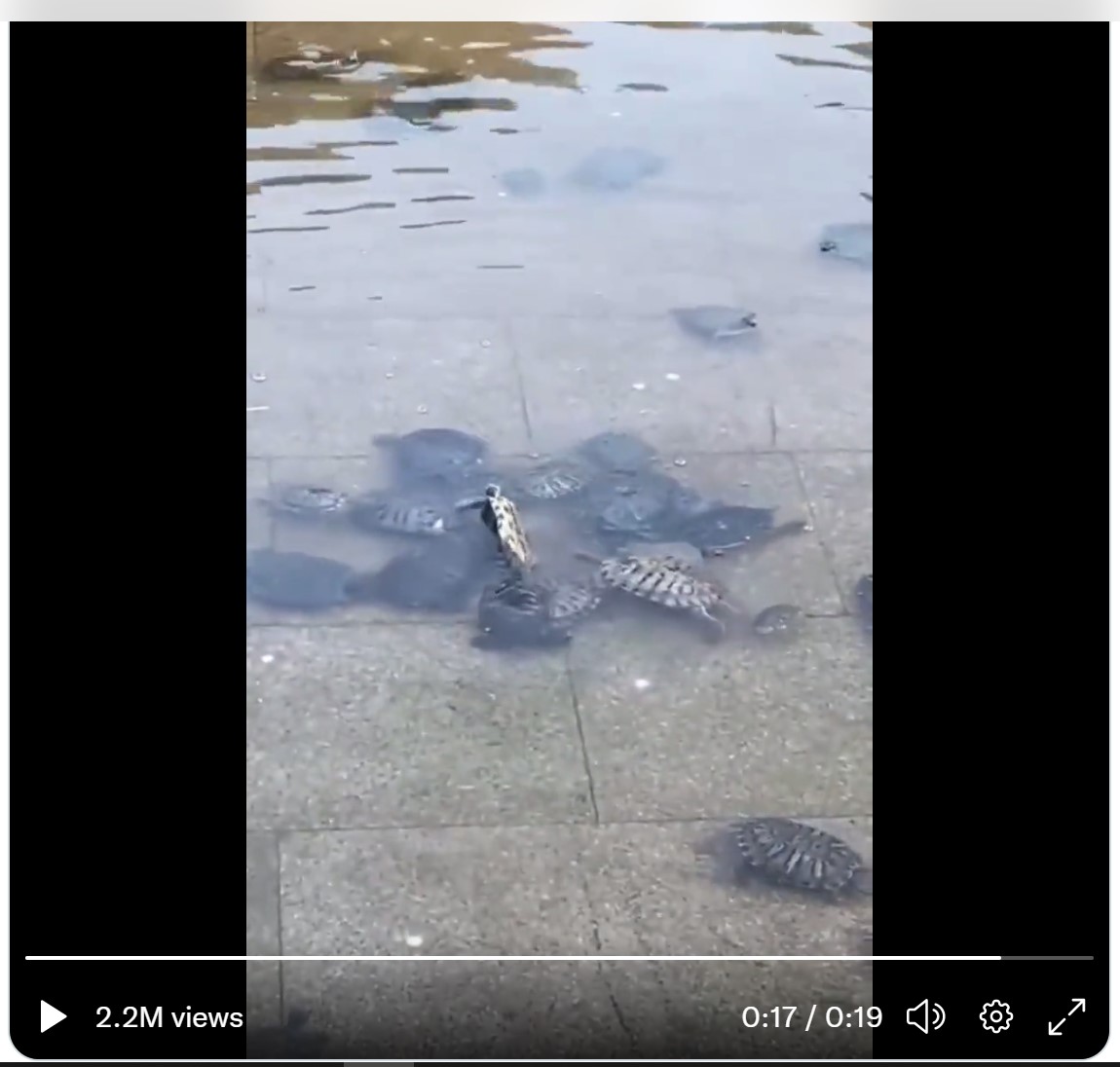
In the video, a turtle flaps around on its back in a shallow pool, going round and round in circles as it struggles to right itself. A number of other turtles are nearby, and up to this point were just swimming around in a very turtle-like fashion – which always appears relaxed and a little random (although who are we to know what turtles are actually thinking, and what guides their movements?). Once the distress of the turtle becomes clear, however, the nearby turtles converge on the position of their suffering acquaintance, and combine to form a supportive wall which, with a few nudges, enables the turtle to be flipped back over on to its front, and return to its swimming.

The turtle being returned to normal

In one of the feeds, the video was accompanied by the hashtag #KindnessMatters, and I thought this was a beautiful way to caption the metaphor inspired by these turtles. I don’t know if turtles can be kind or not, but they certainly made a difference through their actions. They spotted another turtle in distress, they came together – it took more than one turtle to form the wall – and then they acted thereby saving the turtle in distress. When others are in distress, we need to step up and form part of their protective wall; when we are in distress, we need to find our fellow turtles.

An uplifting model upon which to reflect as we start another week. Onwards and upwards!

‘no one is talking about this’

I spent part of my weekend reading a book I had been given for Christmas, and for which I just hadn’t found time or focus until now – Patricia Lockwood’s ‘no one is talking about this’. I won’t spoil the story, but – emerging from the whirlwind of the experience – I recommend it. It is not an easy read, though, and is probably compelling and repelling in equal measure, certainly to begin with. It flows through the world of the internet – the ‘portal’ – and the confusing, affirming, repulsive, attracting, all-consuming content of the messages therein. Where they clash – and fuse – with ‘real’ life is where the novel (Lockwood’s debut novel) finds its feet.

I treated myself to discipline and openness when I read this book – it was a gift, and I deliberately did not read about it, or prepare myself in advance through research … so much of what we do in life is expected and anticipated, and it can be refreshing to – quite simply – not know what is going to happen. As a result, the book hit me between the eyes, causing me to reel and totter, not always knowing where it was heading, but – as I breathed in its deliberate adeptness and at times astonishingly juxtapositional vocabulary – evolving a sense of emerging perhaps-ness, which arguably transmuted into purpose…

It is really hard to write about the details without spoiling the story, and so I shall not do so! I wanted to share, however, my euphoria at the bewilderment born of creative dislocation, of the use of words which floated, seeded, bounced and rebounded … the joy and terror of language made visible on the page… the joy and terror of not knowing what the next page would hold … what a way to spend a weekend!

Now, of course, being me, I will go away and read more about the author and her work, and I will – again, of course – have to re-read the book with a different, more pre-loaded, knowledgeable lens. In fact, I am ahead even of myself; I have just been reading about her experimental and dislocating prose and poetry, and marvelling at it.

Bathing in the creativity of other human beings is sometimes just the tonic we all need. What amazing beings, we human beings can be …

Surprising revelations about the Duke of Edinburgh

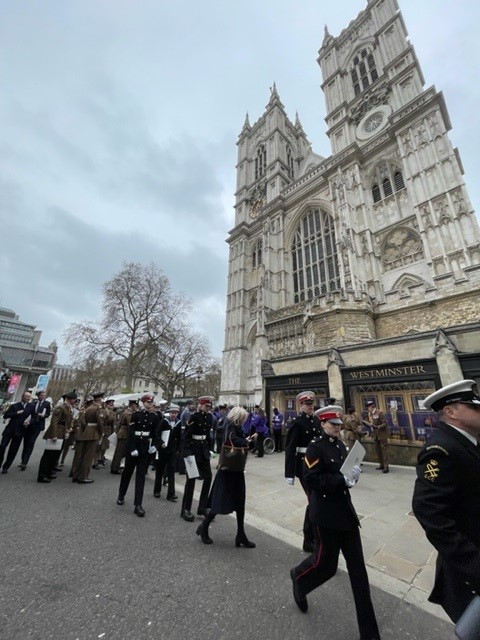
I have had a number of surprising conversations this past week with a number of people, all of which have made me reflect on the impact we have in our life through the actions we take. These conversations have been about the late Duke of Edinburgh, who died last year, and whose Memorial Service took place at Westminster Abbey last Tuesday; I felt hugely privileged to be invited to the service, in my capacity as Chair of ESU Scotland, along with the Deputy Chair, and it was indeed a very special occasion. The music filled the cavernous and beautiful space, the words of the speakers were potent and truthful, and the atmosphere was respectful and yet also joyous. The service was perfectly executed, and was, in fact, in a very satisfying way, all that I had expected.

Westminster Abbey after the Memorial Service for the Duke of Edinburgh on 29 March 2022

What I hadn’t expected, however, was what I would discover afterwards. Such an experience merits retelling (well, I wanted to share my excitement and joy, at any rate …), and as I retold the event to a number of friends and colleagues, I found, to my surprise, that almost every single one had a memory of the Duke of Edinburgh, and could talk about the impact he had had on their lives. (I met him once too, in fact, and chuckled at the time at his acerbic wit!) These memories of others ranged from having met him in person – many amusing anecdotes! – to having participated in projects which he supported, including the Duke of Edinburgh’s Award Scheme, which has been a powerful force for good over several decades (and continues to be so). What was remarkable was that almost everyone I spoke to felt as though the Duke of Edinburgh had had a personal impact on their lives, and that – crucially – they were grateful to him.

The Duke of Edinburgh had an influential (and financially privileged) position in life, to be sure; he could, however, have used this position in a number of different ways, and he chose to have a positive impact. Not all of us will have the same range of opportunities to have a positive impact on the lives of others, but in actual fact, particularly if we think in percentage terms, we could all have the same impact, if we choose to do so. When we do something good, then the ripple effects can spread far and wide. If every action we take is a positive one, then just think about the wider impact this will have, as people feel good, and even tell others. One person CAN make a difference, and that one person is, in fact, each one of us.

So … let’s consider our legacy, and make every effort in the days, weeks, months and years that we have ahead of us, to do what is right and good (and I am not going to try to define that – you know what it is …). Continue to have the most positive impact you can on the lives of others … and a heartfelt thank you for what you have done so far!

Celebrating the positive despite adversity

Sometimes the weight of the stories reported in daily news bulletins can, quite simply, be overwhelming. Pestilence, War, Famine, Death … if we listen carefully, can we hear the thunderous hooves of the Four Horsemen? Fear and anxiety certainly inhibit the creative act of putting pen to paper, or fingers to keyboard, to capture and communicate the positive and the optimistic; it almost felt disloyal to fellow human beings to do this, when so much suffering was so evident on our screens.

One event this week, however, both lifted my spirits and brought back my resolution to communicate with deliberately focused optimism. On International Women’s Day, I spent a joyous hour, in my capacity as President of Changing the Chemistry, chairing an online panel for HSBC’s national Balance group, whose key focus is on diversity. The topic was ‘Being Board Ready – the how, what, when & who?’, and the purpose was to encourage the participants to believe that they could – and should! – put themselves forward for Board roles, and not be put off by any perceived hurdles. We explored the Board journeys of the wonderful participants – Kim Atkinson, Margaret McCaig, Nik Bobb and Silka Patel – and listened to advice in what turned out to be a super conversation, ably aided in the background by Susan Rowand and Brian Hunter, co-leads of the HSBC Balance group.

Key messages to emerge were how fulfilling it was for individuals to take up Board roles, how we all have something unique to bring, and how everyone benefits when we contribute to a Board – including our own employers, who gain a more motivated, more skilled, more experienced employee. We had over 80 participants, and the poll at the end showed a significant uplift in the number of people who would now consider applying for a Board role. What a success!!

Above all, though, it was immensely fun! It was fantastic to meet all the other panellists, some of whom I was meeting for the first time (although obviously, as a good Chair ?, I had been in contact in advance, and had planned the outline and questions). I genuinely enjoy finding out about people and their journeys, and I love the thrill of shaping a meaningful conversation which has an important purpose … there is a reason why I position myself to chair meetings, panels, Boards … We laughed, we shared, we had impact … what was there not to like about that?! And it was all in celebration of International Women’s Day, the theme of which this year was ‘Breaking the Bias’.

This was a bright and energising moment in a world which can make it difficult at times to feel bright and energised … let us grasp and savour these moments, and then use them as a foundation to empower us to play our part to help create the world in which we want to live, and which we want to leave as a legacy for our children.

It’s getting lighter!

One of the joys of living at a latitude of 55.953251 is that the change in seasons every year is really quite dramatic. It is a marvellous source of conversational material – almost every interaction I have had this past week has been punctuated by references to the current change in the season. ‘It’s definitely getting lighter’, said with a contented smile, has been the staple introduction to many a conversation in the street with neighbours lately – and the follow-up, a few days’ later, of ‘It’s getting even lighter!’, is equally satisfying. Conversation on the topic of the seasons is trumped only by the weather, as in ‘Gosh, it is windy today!’ … and even in these circumstances, we find ourselves turning back, with unadulterated pleasure, to the issue of the light, and remarking how, yes, it definitely is getting even lighter.

Of course, none of this should be a surprise – the earth has been orbiting the sun for millions of years, maintaining (we suppose) the tilt that means a single spot on the earth will become progressively further away from the sun, and then closer, every single earth year since (literally) forever. Surely by now we should be used to it? Surely by now the change in the seasons should have lost its lustre?

And yet – what joy these changes bring! The change in the light brings the thrill of finding that exact moment when the streetlamps start popping off, one by one, on the walk to or from regular school drop-offs. It brings, too, changes in nature, and the excitement of seeing a snowdrop again for the first time in 12 months, or spotting the first buds on trees. Yes, it is still cold – and there will be spells of iciness ahead, because there always are in March (and April, for that matter …) – but goodness me! The delight brought by the freshness of the green of the shoots, and the anticipation of that long-awaited whiff of glorious blossom … what is there not to love about this time of year?

I could turn this into a metaphor for rebirth, inexorable forward movement, hope, and optimism … it is all of those, and more, of course. But it is also, quite simply, beautiful and amazing. Savour the moment; we are lucky to live on this incredible planet.

Is Amsterdam calling …?

One of the hats I wear is that of the Chair of the Supervisory Board of the British School of Amsterdam – a role in which I have sought to do my bit for the school since December 2019, having joined the Board in 2017. It is a great school – no question of this! – and is now seeking a new Principal, as the esteemed current Principal, Paul Morgan, moves to take up the role of Headmaster at St Julian’s in Portugal in September of this year. Paul has more than done his bit for the school – it is unrecognisable since he took over, not least because of the major move which took place last year to a wonderfully renovated historic building in Amsterdam, which meant that all 3 sections of the school could come together under one roof for the first time. The school is going from strength to strength, growing in numbers; bottom line, it is a really splendid place to be, with a clear vision and mission for the future.

So … the school is looking for a new Principal … could this, perhaps, be you? ?

I won’t repeat all of the information provided by the school for the role, because you can find this here; you also don’t need me, I am sure, to wax lyrical about the quality of life in Amsterdam, which I am certain you will already know is high. What we are seeking at the British School of Amsterdam is an experienced leader, who can consolidate the work undertaken so far, and take the school to the next level. It is a great role … and the Supervisory Board is pretty good, too!

Do have a look at the details, do pass them on, and do feel free to contact me for a chat …

These are exciting times!

Happy New Year!

At the dawn of 2022, let us commit to making it a year of hope!

In doing so, I wanted to reflect back on my experience in late 2021, when I was lucky enough to visit the vast learning emporium that is Expo 2020 Dubai. Delayed for a year because of the pandemic, but nonetheless (in fact, arguably more) potent for this delay, the Expo site contains an astonishing array of pavilions, each dedicated to a different country of the world, as well as a wealth of activities, parades, roving robots, and other events. (It is still running, by the way, albeit with some Covid restrictions, until the end of March 2022, so do think about going … the website itself is worth a visit!)

Anyway, I can’t pretend that when I visited the UK pavilion, I thought it was the most impressive of the country pavilions – far from it; I did smile, though, when one of my companions for the day commented that it was utterly authentic, as British people love to feel disappointed with their own country! The more I have reflected on the premise behind the pavilion, however, the more it has grown on me, to the point where – in the spirit of positive hope at the start of a new year – I have embraced it, and appreciate its wider value to the world.

The concept embedded in the construction of the UK pavilion was inspired by one of the last projects in which the late Professor Stephen Hawking, was involved – ‘Breakthrough Message’. This project was part of the Breakthrough Initiatives launched in 2015 – “a suite of space science programs investigating the fundamental questions of life in the Universe: Are we alone? Are there habitable worlds in our galactic neighborhood? Can we make the great leap to the stars? And can we think and act together – as one world in the cosmos?”. ‘Breakthrough Message’ focuses within this collection of programmes on thinking about what messages we – the human race – would seek to communicate as a planet, should we ever encounter other civilisations in space, and the main activity at the UK pavilion was to create a massive poem constructed using the words we would choose to share with other inhabitants of the universe.

After walking up the slope to the top of the UK pavilion, I entered the main auditorium, and was faced by an enormous wall with a set of screens, each of which contained a word recently chosen by a visitor. Every visitor is asked to think of a word, enter it into a tablet, and then the AI behind the process (about which I would fascinated to learn more) creates a unique couplet which is then added to what will be, by the end of March 2022, the longest poem ever created by an artificial intelligence, using the input of humans.

My word was ‘together’ – a small but, I felt, meaningful, contribution to this global project, because I was reflecting on how the entire Expo is fundamentally about togetherness, harmony, and sustainability based on co-operation, collaboration … and hope for a positive, better, future. It was incredibly uplifting.

So … a hopeful message for the year, the decade and century ahead. And as a small point of practical action, let’s commit to choosing our words carefully with those around us, in public and in private. For you never know who might be listening …