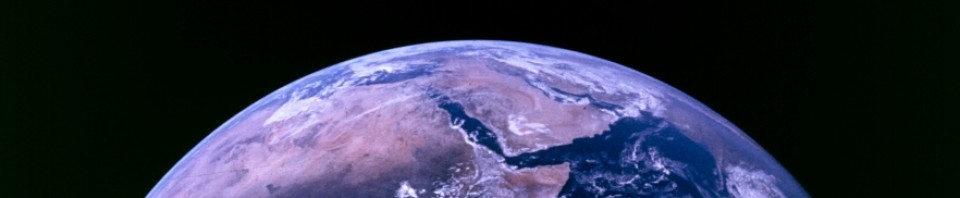
It was a delicious surprise, arriving from home to Edinburgh Airport 2 weeks ago, to discover that my flight down to London – the first leg of my much longer journey to Hong Kong – …
I finished reading Careless People, Sarah Wynn-Williams’ account of her years at Facebook, while I was still in Sydney recently, and – despite the uplift to my spirits that always comes when I spend time …
Last Saturday morning, towards the end of my short visit to Sydney, I hopped on to the train into the city and sauntered cheerily down towards Circular Quay for a matinee performance of The Merry …
Sitting in a taxi this morning on my way to Edinburgh Airport, enjoying the freshness and extraordinary light of a 4.30 am foray into the Scottish landscape, about to exchange the Scottish summer for the …
In a moment of pure and wonderful self-indulgence last week, I booked a last-minute – by which I mean actually on the day – ticket to see Cole Porter’s ‘High Society’ at the Barbican in …
When I studied French at school, one of the books we read was the classic Le Petit Prince, by Antoine de Saint-Exupéry, and I remember still my slight feeling of perplexment about why we were reading what seemed, to all intents and purposes, a simple children’s book. I was an avid reader as a child, as my parents will testify, and was used to tearing my way voraciously through lengthy novels; I could understand that we might need to read something a little simpler in a foreign language which we were still learning … but really? A children’s book?
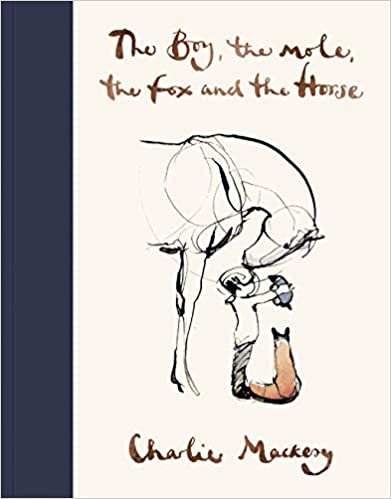
Le Petit Prince, of course, is not really a children’s book at all, but an opportunity to reflect on the absurdities of the human race – a realisation which I acquired to a limited extent while studying the book, but which it took me several years more really to appreciate, and which coincided with my (still dawning) understanding that reading is an art best indulged in slowly. Reading quickly still serves me very well in most of my working life, from board papers to books containing intriguing perspectives on ideas about how the world/humanity/education/society/business could function better, many of which occupy my bookshelves. When faced in my holiday reading with the recommendation from a friend of a beautiful book like The Boy, the Mole, the Fox and the Horse, however, to read quickly would be entirely disrespectful, and a deeper savouring is not just recommended – it is obligatory.
The Boy, the Mole, the Fox and the Horse is an indulgence in the senses, from the texture of the cover to the size and weight of the pages, and from the fluid ink drawings to the simple – and profound – words and interactions. There is no plot, no thesis, no structured plan for action … it offers itself to the reader as an enticing and compelling world which has a moral framework, but in which we must engage and allow our imaginations to meld and mesh with the words and pictures in order to create meaning. I laughed and felt sad, and when I had ‘finished’, I knew I had only scratched the surface and am already drawn to return. Slow reading uncovers, gently, meaning, I am (still) discovering.
Upon revisiting Le Petit Prince recently, on a trip down memory lane, I was surprised to see that it contained many more words than I had remembered. The core simplicity of the messages, though, had remained with me throughout all those years. Fewer words, deeper meaning … maybe that was one of the most important lessons of all from my French studies at school.
I have had a week of feeling proud – proud of so many school
leaders I know, who have risen with grit and resilience to the challenges they
have faced, proud of my executive leadership coachees who have reached the end
of their programmes and who are evidently stronger and more focused … proud –
insanely proud, in fact – of my 17 year old son. I hasten to say that this
pride does not mean that he is some sort of angel, or that he doesn’t make me
cross sometimes, or that he doesn’t upset me … and it certainly doesn’t mean
that he would appreciate me writing this blog, but as he resolutely does not
follow me on social media, then I reckon I am fairly safe in writing this, as
long as you don’t tell him. And if he does find out, well … I don’t mind. I am
too immensely proud for that, and I became his biggest advocate and supporter
when I gave birth to him. There’s no changing that.
So, why am I so proud? Well, for the first month and a half (at least) of our lockdown here in the UK, he chose not to go outside at all. We talked about this, and I respected his decision, as it was a very reasoned thought process based on his strong desire to protect the rest of our family from any contact with Covid-19. With the advent of June, however, he decided to take on a challenge set every year by one of his teachers at Broughton High School, Edinburgh, namely DARED – Do A Run Every Day for charity. Harry decided that he would do this; I, meantime, was careful not to show too much of my enthusiasm, in case that might jinx his intentions (a choice which many parents of teenagers will recognise…), so I simply signed him up and started off by contributing to his sponsorship goal, which he set at £50, raising money for Circle, which supports families in need across Scotland.
The original plan was to do 5km a day, and he set out to do
this, every day without fail. Then, within a few days, he started running for
longer distances, and then longer. By 15th June he was running over
10km a day. He ran around Arthur’s Seat one day – 15.8km – and then another day
to Cramond and back (18.5km). Then he ran to Portobello and back (18.8km), and
then he ran to Fairmilehead and Mortonhall – 21km! His longest run to date was
this one, towards the end of last week –
I asked him why, and in his typically dry manner he just
said he did it because he could, although I know by some of his comments posted
beside his runs, that he was striving to do just that bit better, to reach the
next goal, be it 10k or 20k, or to achieve the longest run to date. What he has
yet to appreciate, perhaps, is quite how much of an inspiring example this
sets, and what a delight this is for educators to see, as well as for parents –
and, indeed, for other fellow human beings. Determination, commitment, a growth
mindset, a belief that everything is possible if you set your mind to it … this
is an attitude to lift the soul of us all, especially when these qualities are
employed in pursuit of a goal to support others.
So far – and I am writing this on 28 June, so with still 2 days to go – he has run over 275km and has raised over £800 for Circle, thanks to some absolutely amazing donors, who have commented on his JustGiving page that they are feeling inspired and proud of him too. I share in their delight.
I was delighted to see Julie Robinson’s call to action last week, encouraging people to apply to become school governors, and I urge you to watch it. Julie is the CEO of the UK Independent Schools’ Council, representing the organisations which support the vast majority of independent schools throughout the country, and she is also one of the most committed advocates I know for social mobility and community engagement through education; her call to action is equally on behalf of state as well as independent schools. If you have ever considered being a school governor – or even if you have never considered it – then now is the time to apply, to support schools and their leaders as they navigate some of the toughest and most challenging times they have ever experienced.
What, though, do school leaders need from their board
members? While coaching and supporting school leaders across the world over the
past 6 years, since leaving school Headship myself, I have noted the emergence
of a number of crystal-clear themes – themes which apply to every single type
of school, wherever they are on the globe, and whatever structure they have. The
following lists draw together some of these observations …
School leaders need a board which:
collectively has a deep, shared and coherent
understanding of a vision for the school, as well as its current reality and
challenges;
contains a group of people with diverse
perspectives and a range of backgrounds, so that they can bring a range of
viewpoints and spot areas or gaps or assumptions which might not be evident to
the leader or others on the board;
is unafraid to use its voice, but which
recognises the equal importance of appropriate support and keen, insightful challenge;
channels active energy effectively into what
really matters, usually supported in this by sensible structures such as
committees and the guidance of a board chair who is wise enough to know that
they are only a part of the structure;
recognises that its purpose is not to manage the
school, but to provide governance for it … and so which has been prepared to
learn what good governance really is.
What they don’t need is a board which:
panics;
is swayed in its decision-making by board members
who bring what they hear in the playground into the boardroom and define this
as ‘fact’;
believes that its role is to invent multiple
initiatives and expects them to be adopted by the school leadership team,
without due consideration of the impact of these, and whether they properly
further the vision;
is negligent, not challenging the numbers and
statements made by the leadership team – appropriate and strong challenge is
one of the vital elements of the value that board members bring;
which does not build a sense of their corporate
responsibility, part of which will almost certainly include connecting either
with each other and the school leadership beyond attendance at meetings.
Over the past few months I have heard tales of two extremes
of governance in schools … and the best of these have been of boards which have
taken their responsibilities for the future of the school seriously, meeting
regularly online, adapting their processes to work around the pressures on
their school leaders, and stepping up both their level of scrutiny and of
support. As most governors do this work entirely voluntarily, this has been a
huge ask of them – they have been playing a very real and valuable part in the
worldwide crisis which we are all experiencing.
It is almost certainly a fact that crises will tend to bring
out the best and the worst in people; schools – the engines of our society,
which have been dramatically affected by the restrictions imposed as a result
of the fight against Covid-19 – deserve the absolute best from people.
Last week, a fellow Light Up Learning Board member came across this 2016 article from The Atlantic, and I thought it was particularly apt at this moment to share it in our history, as we all try to work out how to move definitively away from systemic, ingrained racism in our world. Written by Paul Tough, whose 2009 book ‘Whatever It Takes: Geoffrey Canada’s Quest to Change Harlem and America’ profiled the black American educator, Geoffrey Canada, this article is a long but perceptive and well-reasoned read, exploring how children and young people learn the resilience we believe (and know) they need in order to thrive equally in the world.
Its key message is that young people need 4 important
mindsets or beliefs if they are going to be able to persevere:
A sense of belonging – ‘I belong here’
A growth mindset – ‘my ability and competence
grow with my effort’
A sense of self – ‘I can succeed at this’
A sense of purpose – ‘this work has value for
me’
Children who grow up in adverse circumstances, however, often don’t believe any of these things. Schools can make a difference, and I have seen schools do fabulous work in mindsets 2-4 especially. It struck me, while reading the article and reflecting, and while reading heartrending accounts over the weekend of the exclusion felt by black and minority ethnic people, that where we can all do so, so much better is in developing and sustaining a real sense of belonging. Schools, families, mentors, coaches … everyone can play their part in making this happen. We are all in this together, we are all genuinely equal, we should all belong … And we have to stand up, say this, mean it, and do something about it.
Change often happens not as a smooth evolution, but more
akin to the movement of tectonic plates, with a build up of intolerable
pressure until they can stand no more, the earth gives way in a resounding
earthquake, and new land is formed. George Floyd’s death released the tectonic
plates. let us regroup on the new ground, as equals, where we all belong
together.
There is no going back in life, only forward. Let’s do it
side by side, listening to the hurt of the past, illuminating the real stories,
redressing the issue of privilege, with humility and sorrow, but with hope for
the future, and a determination to ensure we all, all, all have an equal sense
of belonging in this world.
Once Upon A Time, roughly 9 weeks ago, when everyone in the
UK was instructed to stay at home, there was a mini (but nonetheless
confronting) crisis in Edinburgh, when root ginger for purchase was nowhere to
be found. ‘Sorry, not available’ were the words stamped across online orders,
and even kind neighbours who ventured out for shopping reported few sightings.
Great was the rejoicing on our (newly created) street WhatsApp group when a
neighbour returned triumphantly from a foray to a local shop, clutching a
rhizome or two to divvy up and post through our letterboxes.
Before you snort, and dismiss this search for scarcity as a
‘first world problem’, do let me remind you that while, yes, none of us was
about to die if we did not acquire this food, ginger is in fact a staple spice
used for culinary and medicinal purposes across the world, at all levels of
society. Widely valued for its anti-inflammatory purposes, it falls into the ‘this
is good for you’ pile of foods. Besides, it has an ancient history and is what
might be described as a ‘globally connecting’ food, given its journey across
cultures, and across human history. Should you need more information, Wikipedia
reports that:
“Ginger originated in Island Southeast Asia and was likely domesticated first by the Austronesian peoples. It was transported with them throughout the Indo-Pacific during the Austronesian expansion (c. 5,000 BP), reaching as far as Hawaii. Ginger is one of the first spices to have been exported from Asia, arriving in Europe with the spice trade, and was used by ancient Greeks and Romans. … In 2018, world production of ginger was 2.8 million tonnes, led by India with 32% of the world total.”
A global food indeed. Moreover – and critically – our
communal hunt for ginger in our small street brought us closer. The gratitude
and sense of ‘we’re all in this together, so let’s help each other’ that the
search for root ginger epitomised felt incredibly important at the time, and
still does. As a community, we are still all being asked to play our part in
supporting the fight against Covid-19, and knowing that we are not alone, and
that there are people close by to help and support us if needed, was (and is)
really significant in being able to sustain this. Besides, I have many lovely
new friends now, for which I am hugely thankful.
Anyway, the ginger story did not stop here, even though root
ginger – to everyone’s relief – soon became widely available again. The
experience of its scarcity, however, made me wonder whether it might be
possible to grow the plant at a latitude of 55.95°N, to sustain us in lean
moments ahead. Extensive research online and with friends suggested an
ambiguous response to this question, hovering around the ‘possibly yes,
possibly no’ mark, so I decided to apply
a filter of positivity and plump for ‘well, let’s try’. I tracked down a
company in the north of Scotland which sold ginger rhizomes for planting
(because shop-bought root ginger is usually treated to inhibit growth), and
when it arrived, I planted it. I watered it, placed it as close to the window
as possible, so it would receive some warmth, and waited.
Nothing happened.
I waited another week, then another week, then another.
Still nothing.
A little deflated, I moved the plant pot away from the
window, to make space for the chilli plants and basil, which were exploding in
their growth, but from time to time I checked the soil of the ginger plant pot to
make sure it wasn’t drying out.
Still nothing happened.
And then …
A few days ago …
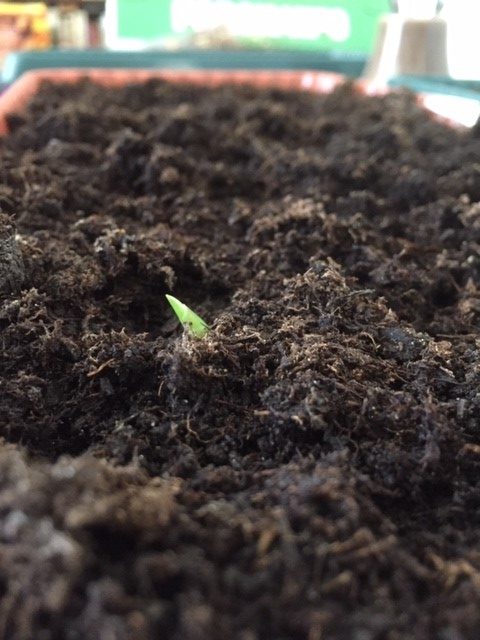
I spotted a tiny, tiny, tiny green shoot, breaking through the surface. It was so tiny that without a very close inspection, you would miss it. And yet, it was undeniably there. The ginger plant was growing! Very, very, very slowly, admittedly, and almost certainly at such a fragile time in its lifespan that its existence hovers between life and death. But it is there, a triumph of nature and a living metaphor for almost too many aspects of our current situation to list – including the power of patience, the importance of learning to trust what we cannot control, and how it is within our own grasp to turn, resolutely, loss into positive action.
I am inordinately delighted with my living metaphor, so much
so that I wanted to share this experience as a fable. Were I still a school
leader, I would have material in this one story for several of next term’s
assemblies; watch out for its resurgence in my motivational talks. You heard it
here first.
After all, when we determinedly turn negatives into
positives, draw on the support of those around us, and share, then – and I do
absolutely, tenaciously and unwaveringly believe this – we take one step closer
to living, as the fairy tale says, happily ever after.
I very much enjoyed leading two virtual professional development sessions at the Lasswade High School Learning Festival for staff on Monday of this week – I wish I could have stayed longer! I spent the time sharing – as swiftly as I could – some of the experiences I have gained from working internationally with school leaders over the past 4 months especially, as teachers and school leaders everywhere have navigated the shift to online learning, and managed the continued, ongoing, demands of responding to student needs virtually, through the digital medium. Teachers all over the world have proved themselves incredibly adept at making this shift; the teachers I met on Monday were no exception.
I referred in my presentation at Lasswade High School to John Hattie’s latest article on the effects of the Christchurch earthquake on student attainment, and highlighted that – contrary to expectations – the grades of students who missed considerable time in school because of the disaster were, in fact, by the following year actually higher than anticipated. The students appeared not to have suffered at all academically, and the reason for this became clear to the researchers when they delved deeper into how teachers had responded to their students’ needs. The teachers had, it was revealed, worked out exactly what their students really needed, and had provided the interventions that matched these needs; rather than concentrating on teaching them what it previously generally thought that they needed (ie the scheduled curriculum), the teachers identified gaps in their students’ skills and knowledge, and helped them fill these. Motivated by the first principles of teaching – ie enabling young people to develop and thrive – they broke free of prior expectations and did what really worked.
Quite apart from reassuring teachers who are worried about the future of their students, this research should also embolden them. In this week’s TES, John Morgan writes in an excellent and thoughtful article about studies into the risks of re-opening schools, that “there is no ‘the science’ – no single point of scientific consensus”, and exactly the same applies, I would argue, to the ‘science’ of e-learning. There is no single method of e-learning that can be described as a magic bullet – although there are plenty of examples of interesting practice; what is emerging more and more clearly, however, is an understanding that when teachers identify the specific needs of individual students, and work with these, then progress happens.
Sound familiar? Well, this is exactly what teachers are
superb at doing – understanding their students and then working out what they
need in order to fly. These aren’t always conventional, off-the-shelf methods,
and they certainly aren’t applicable to all. All that holds teachers back is a
lack of resource and trust.
So let’s give this resource and trust to teachers, let
school leaders make decisions which work for their own students in their
particular communities, and let educators – quite simply – all just do their
jobs.
My calendar reminded me this weekend that I should be headed to Sydney in a month’s time for my annual business and coaching trip … obviously cancelled for this year as borders remain firmly closed for the foreseeable future. I was also reminded, however, of one of the many enriching experiences I had when I was in Australia last year. Last June, I popped into a bookshop in Manly, and happened to come across some detective fiction books by an Australian author whose work I hadn’t come across before, but who had obviously achieved some acclaim, as at least one of her books had featured in The Sunday Times Top Ten Bestseller List. Her name was Jane Harper, and while her books looked fascinating, I knew that I wouldn’t have space to carry them back with me, so I reserved them online on the City of Edinburgh Libraries website, and picked them up almost as soon as I returned home.
I finished all three – enjoyable light reads, with stimulating twists and quirks, and I was particularly struck by the evocation of the Australian wilderness, of which I have had some experience, albeit temporary, fleeting and superficial … even to glimpse it, however, is to be awed. Once seen, never forgotten.
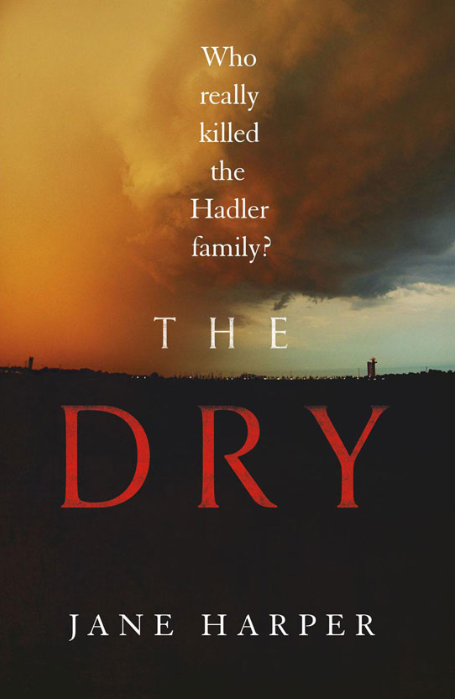
One phrase in Jane Harper’s The Dry struck me between the eyes as soon as I read it, and has lodged itself in my brain; I cannot shake it. Breathtakingly unsettling, it captures exactly the stifling experience of apparent nothingness in the unimaginably enormous, dry Australian desert, made more poignant because of the subsequent bushfires in the country only a few months after I read the book. The phrase comes in this passage, where the author describes how newcomers feel when they move to a property out in the country …
“On arrival, as the empty moving truck disappeared from sight, they gazed around and were always taken aback by the crushing vastness of the open land. The space was the thing that hit them first. There was so much of it. There was enough to drown in. To look out and see not another soul between you and the horizon could be a strange and disturbing sight.”
“Crushing vastness” …. words on a page, yes, but also a powerful blow to my consciousness, recalling and intensifying previous experiences, and giving words to shape them and draw meaning out of them. In that moment of reading, there was a fusion of past and present, real and imaginary; and a truth emerged. I’d like to think that everyone who has ever read has had this experience; if not, keep reading until you do …
Reading
works the other way round too; think about the times when you have read a book,
and then – months or years later – have had an experience which triggered the
memory of the words on the page, by which suddenly made sense of them. Again,
if this has not happened to you yet, keep reading!!
Reading books opens doors to new worlds and to parts of our existing world which we have not yet fully explored. Especially at this time in our history, when physical travel is impossible, I cannot imagine a world without the richness of reading and books. Can you?
Working with clinical psychologist Dr Danielle Einstein on her school programs to help students manage uncertainty is a real pleasure – and, given that she is in Sydney and I am in the UK, it is also proof (should any more actually be required in this Covid-era) that it is perfectly possible to collaborate effectively at a physical distance. We are in daily contact; sometimes I correspond with the schools who have taken up her ‘Covid-19 Chilled and Considerate’ program, and sometimes she is their point of contact; we both attend and lead the twice-weekly Zoom support calls, and in between we continue to refine the programs based on feedback from schools. This feedback is incredibly helpful, and all 3 of the programs now being used – for Years 5 and 6, for Years 7-11, and for Year 12 – have become even richer and more impactful.
I know I am biased, but I can’t help but feel proud of these programs – and it was great to see a really positive mention of them in the Sydney Morning Herald on Sunday. What I have noticed is that the key concepts included in the program, all of which are presented really memorably, with (as you would expect!) a range of exercises to help school students practise and reflect, are just as important for adults as well as young people, and I find myself increasingly referring to them in my executive coaching. Leaders often think about anxiety, and how to tackle this, but not about the uncertainty which is probably underpinning this anxiety. Learning how to manage uncertainty is a lifelong skill – research shows that people who are afraid of their anxiety and who naturally do not like uncertainty demonstrate the greatest level of worry (ie anxious thoughts), which can – as we know – be cripplingly disempowering.
One of the central concepts of the program is that of the
‘uncertainty bomb’, which lies waiting for us when we encounter a situation
whose outcome is not immediately obvious. Mishandle this bomb, and it will blow
up in our faces; handle it well, using the techniques from the uncertainty
toolbox, and it will be defused. Of course, this is easy to talk about; what is
important is really to understand, learn and practise. The programs are based
on years of research by Dr Einstein in clinical psychology into handling
uncertainty, which has informed the past 8 years of her work specifically in
schools, and while these schools have largely been in Australia, I can
absolutely see the universal significance of these programs in schools across
the world, and their usefulness for school students especially, but by
extension for teachers, school leaders, parents … everyone, in fact. In helping
us deal with uncertainty, they respond to a basic human issue – an issue which
we are all, wherever we are in the world, facing more keenly than probably ever
before in our living history.
With this in mind, Dr Einstein has already produced a parent
workshop, and more is to follow; in the meantime, I would be particularly keen
to help schools in different parts of the world access the programs, and if you
are a teacher or school leader who is interested, please do get in touch.
Together, we can do this, and make a difference!
This title is a quote from a new blog I am very much enjoying reading – not just because the author (a former English teacher and school leader) is an old friend, but because the ideas are pithy, clear and immensely practical. The blogs – which can be found at readwritetalklisten.com – are addressed directly at thoughtful teenagers (and younger students); if you know any teenagers with slightly more latent thoughtfulness, it would be perfectly legitimate to read the ideas on their behalf and then pass them on, because if we could all, gently, adopt some of the ideas contained therein, I suspect that our self-awareness, our awareness of the world, and our connections with others will all subtly improve … and wouldn’t that be a great outcome to emerge from this Covid-19 time?
One of the signposts the author plants is to materials recently uploaded by the Director of the Speak Up Scotland programme developed by ESU Scotland, and these are definitely worth a look. I do declare an interest – it is another of the charities I chair, because I consider its goals incredibly worthwhile. Debating is a means of exploring and articulating ideas, and is an enjoyable and satisfying skill to acquire. It is also a means to be able to contribute to society and make one’s way within it – on equal terms with others, regardless of background. No Prime Minister ever became Prime Minister without a strong grasp of the practice of debating. Speak Up Scotland, therefore, is aimed at bringing debating – which thrives in the independent school sector – to state schools across the country, and by doing so, is a way to lessen the poverty-related attainment gap which we must still tackle.
The materials are aimed both at teachers – a detailed set of
proposals, for instance, on how to debate during lockdown – and at eager student
debaters, who will find that ‘Intuitions, Examples and Analogies’ sharpens
their skills. More are to follow, I am promised, so bookmark the page. The
important message for us all is that communication really, really matters, and
we should be practising it now, more than ever. Human beings are infinitely
creative in their ability to circumvent – and even thrive more successfully in
– whatever restrictive circumstances they encounter, and we have seen a myriad
of examples of this over the past few months, as Covid-19 has spread across the
world. Let’s be emboldened by this; we know already that we can connect through
multiple forms of communication … why not spend some time deepening these?
Moving forward into our brave new world as better, more authentic, more
effective communicators … now, that feels like a suitably uplifting goal.
I felt uncomfortable reading the Ofqual consultation about school public examinations this week, and I wanted to explore this discomfort a bit further here.
Specifically, what made me uneasy was the proposal that no
appeals will be allowed for exam grades this year: “appeals should only be
allowed on the grounds that the centre made a data error when submitting its
information; or similarly, that the exam board made a mistake when calculating,
assigning or communicating a grade”. Now, to be clear, I can’t offer a specific
alternative to this, and it is of course a recognisable positive that teachers’
professional judgement is being valued. Moreover, if (a slightly big ‘if’ …)
the algorithms to be used in the calculations were to take account of the current
cohort of students and their individual characteristics, rather than just using
historical data and trends, then this would alleviate a little of my
discomfort, because we do need to remember that each student is indeed an
individual, and not simply a predictable point on a typical bell curve.
It does still worry me, however, how this inability to
appeal will impact already disadvantaged students – students who are
disadvantaged through chronic illness, for example, or who are differently
abled, or who have multiple socio-economic hurdles to overcome. These are
students who may not be thriving in the system, who may not have accumulated a
mass of evidence over the year, who may have frustrated their teachers … but who could – just could – perform better in
the exams themselves were they given the opportune circumstances in which to do
so – an option which they now no longer have. Note that the option to take
examinations in the autumn is not a desirable one for many of these students – particularly
for those who have had time out of school through illness, and must guard their
health carefully, these examinations will be part of a carefully scheduled
journey that, if upset, risks potentially severe repercussions and setbacks.
Autumn examinations will also cause significant disruptions in school to next
year’s learning programme –no matter how you package them, exams can’t help but
disrupt learning.
Ofqual is sensitive to the issue of equality, of course – and it has conducted an equality impact review, which is published alongside the consultation. This review does however rely on research which is patchy and inconclusive, and Ofqual accepts that there will de facto be unconscious bias in the awarding of grades, which is uncomfortable to read. Another uncomfortable element to appreciate is that many school students do not receive the quality of teaching which they deserve. The detailed analysis of papers undertaken by Mark My Papers, an organisation whose Advisory Board I chair, and which helps schools, home educators, mature students and tutor groups access professional marking by official examiners, reveals that all too often, specialist subjects are being taught in schools by non-specialists, which leads to whole elements of the curriculum being under-taught. (This analysis is always shared with the specific schools, by the way, to help them refocus their teaching.) Again – a disadvantage imposed on young people because of the failings, weaknesses and gaps in the system. And – hypothetically – if this were the first year that a school had accessed a deep analysis of their teaching, and made amendments, with the anticipation that this would translate into higher grades overall in these summer exams, would this be reflected in the Ofqual algorithms? And if not, where is the justice if the affected students cannot appeal? If these students could take an exam invigilated online and have it sent to professional, independent markers, maybe – maybe – this would help break down at least some of the disadvantage they would otherwise be facing.
Again, to be fair, I do not have an immediate solution
(well, apart from a major revolution in school funding that recognised the fundamental
central role of schools and other education bodies in our global economic and
social future …), but neither do I think that we should brush this discomfort
under our respective tables. How are we tackling this? How could we tackle this
more effectively? What is the best way to help young people overcome the
hurdles in their paths, and to enable them a fair playing field?
In raising this question, I am not advocating a sticking
plaster approach, which automatically slaps a premium of, say, 10% on to grades
of young people who have suffered evident disadvantage. To do so would make a
mockery of all that is good about exam courses – the rigour, the challenge, the
depth of learning, and the skill of being able to recall and evaluate outcomes
of this learning by communicating it to an external, standardised body. None of
this praise for exams, incidentally, detracts from my more general and long
standing concern about the often limited nature of testing methods, and my
question as to whether they allow all types of learners to demonstrate their
learning effectively – this is an equally important question, and in fact ties
together with the question of tackling disadvantage. I just want us to think about how we can
really, really tackle disadvantage and close the attainment gap upwards, by
raising ambitions and developing capacity in young people to make the most of
their potential.
I have recently taken on the role of Chair of LightUpLearning, a charity based in Edinburgh but with plans to move out across Scotland and beyond, which seeks to tackle disadvantage. It does so by providing regular, scheduled time for secondary school students with an experienced, trained, empathetic mentor – a relationship which stands outside the teacher-student dynamic in school, and which places the learner at the centre of every LUL session. This focus on liberating the student to follow their passion, has already been demonstrated to ignite a much more confident engagement with enriching learning, which will of course underpin their current and future success in life and work – including their examination courses. This kind of intervention can make an enormous difference in a short space of time … but how many of our young people are currently able to access this? How many have missed out, who could otherwise have shone in their exams?
So … sitting with this discomfort … I would love us to think
collectively about how we can move forward. It may be that there is nothing
else we can do regarding these exams, although I am always intensely reluctant
to let go of my conviction that there is always a solution, if only we put our
mind to it. At the very least, however, we cannot afford to let this just slip
by without keeping the door at least a little ajar for genuine cases, seen on
their individual merits.
Let us not fail our young people, now more than
ever. And as we seek an exit strategy, remember that we have shown that we can,
nationally, make radical, major decisions – like putting all teaching online –
based on an idea of what can and should work, a commitment to justice and
fairness, and a determination to review, adjust and change nimbly until the end
result does what we want it to do. In unprecedented situations, you cannot wait
for the research to tell you what to do – you have to fuel the research by just
doing it. Maybe this is the time to be bolder about tackling disadvantage in
our schools.