Helen Wright

Author's posts

The Pattern Seekers – insights into how different brain structures have saved humanity

If you are looking for a well-referenced, very readable and intriguing but satisfying book which explores why difference in human brains is of value in our development as human beings, then you should read ‘The Pattern Seekers’, by Simon Baron Cohen. It was recommended to me by a very good friend a couple of months …

Continue reading

The importance of discipline in a successful life

I spent a glorious hour last week tuning into a live talk with the author Alexander McCall Smith, hosted by the Caledonian Club in London, but of course all on Zoom (which made it much more accessible, if less social). Anyway, he was, as ever, a delightful speaker – entertaining, modest, self-deprecating, intelligent, with a …

Continue reading

The global power of language learning

I loved reading this article in The Guardian last week about a ‘video pal’ scheme instigated by the University of Warwick during the pandemic and consequent lockdowns; designed to support university students in developing their French language skills despite being unable to travel, it started with 5 students and now has almost 7,000 enrolled, and …

Continue reading

Dusting down and revamping your Board Strategic Plan – 3 easy steps

I wonder … how relevant is your current Board Strategic Plan? You may, of course, have a sparkling, succinct, highly relevant Strategic Plan, which has adapted to the challenges of the last year, and which sets out clearly your goals for the next few years, as well a roadmap and timetable for how you are …

Continue reading

In praise of low self-esteem …

I am currently adding another tool to my executive leadership coaching toolbox by training to deliver the Thomas International TEIQue test, which measures traits underpinning emotional intelligence. As with all psychometric tests, this test uses a series of questions to capture insights into ourselves, which we can use to articulate and understand ourselves; in many …

Continue reading

“Diversity is not an absolute”

I have had such fun this past week! Genuinely! My kind of fun, just to be clear, involves engaging in uplifting dialogue with potential change-makers, with a view to making the world a better place; when I do, in whatever format this is, I come away energised, determined, positive, optimistic … what is not to …

Continue reading

#betterboards course for International School Board members – starting next week!

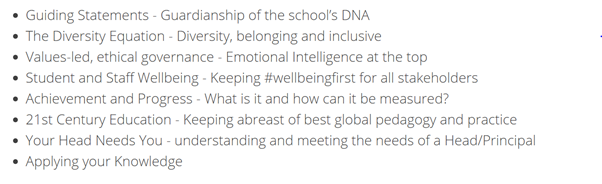
Next week – the week beginning 25 January – Matthew Savage and I will release the first of 8 lessons in the LSC Education #betterboards course designed to help International School Board members focus in on what is really important in International School governance. Joining details will be popping into participants’ mailboxes over the next …

Continue reading

Chessboard thinking? Web thinking? A ‘both/and’ question in navigating the world of relationships.

One of my interesting Christmas holiday reads this year was Anne-Marie Slaughter’s ‘The Chessboard and the Web’; part thesis, part memoir (it is peppered with references to her academic career, and to her time as director of policy planning at the US State Department), it prompted me to think about how we can teach (or, …

Continue reading

Governance and the art of the possible

I think about governance every day – not surprising, really, given the Boards I chair or am involved with – and my reflections have been heightened recently, as, together with Matthew Savage, I have been putting the final touches to our 5 week flexible online course for international school Board members, #betterboards, which is launching …

Continue reading

‘The stark and penetrable reality of diversity and inclusion …’

… is that they are not “nice to haves”.’ So writes Michael Bertolino from EY in a recent Forbes article about leadership in organisations, which you can read here. He lays out convincingly why this is the case, he refers to research which proves it, and he summarises succinctly what companies can do to become …

Continue reading